If you just figured out you have an hourglass body shape, here’s the good news: you’ve drawn the easiest hand in fashion. The hourglass is the proportional reference every other body type is dressing toward. Your bust and hips are roughly the same width, and your waist is clearly defined. That’s it. That’s the whole shape.
But “easy to dress” does not mean “anything looks good on you.” That advice is lazy, and it’s the reason a lot of hourglasses end up in shapeless tops or overly clingy dresses that work against the very curves the rest of us are trying to fake. Your job isn’t to create curves. It’s to stop hiding them.
These 8 rules cover everything you actually need to make smart decisions in a fitting room. Bookmark this and use it next time you shop.
Rule 1: Always Define Your Waist
Your waist is the defining feature of your shape, and if an outfit doesn’t show it, the outfit isn’t working. This is the single most important rule for an hourglass, and the one most worth checking before you leave the house. Cinching, tucking, fitted seams, a belt, a wrap. All of these put the eye where it should go.
Many hourglasses make the mistake of hiding their waist under loose clothing because they think a baggy fit looks slimmer. It doesn’t. It makes you look bigger by erasing the narrowest point of your body. If the silhouette of your outfit is a column from shoulder to hip, you’ve lost the shape you were born with.
Quick check: stand in front of a mirror and look at your outline. Can you see where your waist is? If not, the outfit needs help.
Rule 2: Avoid Both Extremes: Too Tight and Too Loose
Tight clothing exaggerates your curves, and baggy clothing erases them. The sweet spot for an hourglass is fitted, not clingy. You want a piece that skims the body, follows your shape, and stops there.
Why does tight fail? Because curves on top of curves on top of curves becomes too much information. A super tight bodycon dress can read as costume rather than chic, especially with a fuller bust. And why does baggy fail? It hides the one feature most people would kill to have visible.
The test I use: pinch the fabric at your waist. If you can pull more than an inch or so away from your body, it’s too loose. If the seams are straining, it’s too tight. Aim for the in-between.
Rule 3: Wear the Belt — It’s Your Unfair Advantage
Belts at the natural waist are flattering on hourglasses in a way they aren’t on most other shapes. This is one of the rare times the styling advice is genuinely “you can wear what others can’t.” A waist belt over a dress, a blazer, a sweater, or even an oversized t-shirt instantly redraws the silhouette and puts your shape back in the picture.
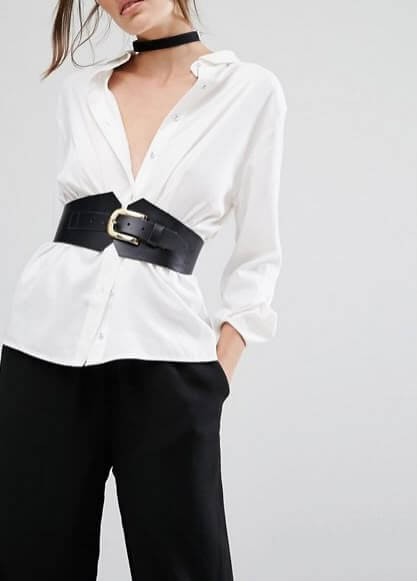
Width depends on the look. Thin belts feel polished and work over fitted dresses. Medium belts (around an inch or two) are the safest everyday choice. Wide statement belts can be striking, but only over simple, fitted pieces. Over an oversized blazer, they’re magic.
Use a belt to rescue any outfit that’s drifting toward boxy. Got an oversized cardigan you love? Belt it. Long shapeless trench? Belt it. The piece doesn’t change. Your silhouette does.
Rule 4: Go High-Waisted Whenever Possible
High-waisted bottoms put the visual line exactly where your body is narrowest, which is the whole game for an hourglass. Jeans, skirts, trousers. High rise wins almost every time. The seam sits at your true waist, your top tucks in cleanly, and the proportion reads instantly as hourglass.
Mid-rise is fine and won’t ruin an outfit, but it cuts across the widest part of your tummy rather than the narrowest part of your torso. Low-rise is a freedom only an hourglass really has, but I’d save it for shorts or a relaxed weekend look. It’s a stylistic choice, not a flattering default.
If you’re shopping for jeans and aren’t sure which rise works, hold the waistband up to your body. The top should hit at or above your belly button. Below that, you’re losing the advantage.
Rule 5: V-Necks and Scoop Necks Balance Your Bust
V-necks elongate the torso and frame your bust without overwhelming it, which is why they’re the safest neckline for almost every hourglass. A V-neck breaks up the visual weight of a fuller bust and creates a long, clean line down the center of the body. Scoop necks do the same thing in a softer way.
Round necks and turtlenecks aren’t off-limits, but they sit higher on the chest and can make a fuller bust look heavier than it is. If you love a crewneck, look for one in a thinner knit or fabric that doesn’t add bulk on top.
Halter necklines are great too. They widen the shoulders, which keeps your top half balanced with your hips. Boat necks work as well. The neckline you really want to be careful with is anything that adds volume right at the chest, like a tight high turtleneck on a fuller bust.
Rule 6: Wrap Dresses and Fitted Dresses Are Your Shortcut
If you want one outfit that always works for an hourglass, it’s a wrap dress. Wrap dresses cinch at the waist, fall cleanly over the hips, and have a built-in V-neck. They’re essentially designed for your body. If you don’t own one, that’s the first piece I’d add to your wardrobe.
Fit-and-flare dresses are the second-easiest win. The fitted bodice and flared skirt mirror your natural proportions exactly. Sheath dresses also work beautifully, as long as they have shaping at the waist. Look for darts or seaming, not just a tube of fabric.
Bodycon dresses are fine for an hourglass, with one caveat: choose a thicker, structured fabric that holds the body rather than clinging to every curve. A flimsy bodycon turns into the “too tight” problem from Rule 2. A structured ponte or scuba bodycon stays on the right side of fitted.
Rule 7: Pencil and A-Line Skirts Both Work, for Different Reasons
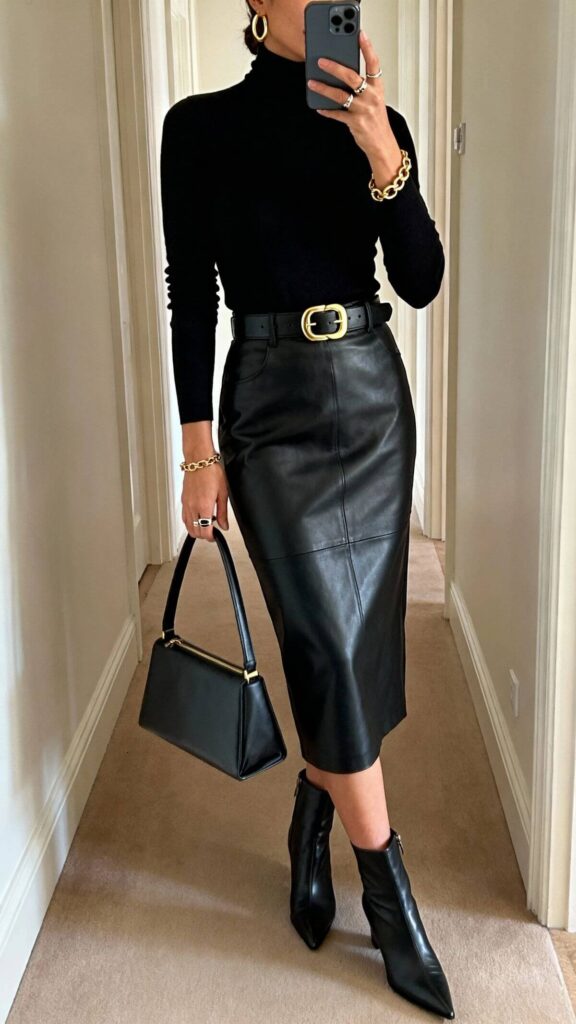
Pencil skirts mirror your shape, and A-line skirts emphasize your waist by exaggerating the hip. Both are flattering on an hourglass, so the choice is about what you want the outfit to do, not whether the skirt “works.”
Pencil skirts give you a sleek, polished line and are read as more formal. They’re great for work and for any look where you want a strong, defined silhouette. Pair them with a tucked-in fitted top or a fitted blouse so the proportion stays balanced.
A-line skirts are more playful and add a little visual width at the hem, which makes the waist look even smaller. They’re an easy daytime choice. Mini A-lines are fun if you want them, but pair them with a fitted top. Otherwise the silhouette tilts toward “too much volume” and you lose the waist.
Rule 8: Match Top and Bottom Volume
When one half of your outfit is voluminous, the other half should be fitted. This is the rule that keeps every other rule working. An oversized sweater needs fitted jeans or a tucked hem. A flowy maxi skirt needs a fitted top. A wide-leg trouser needs something tucked in or a slim knit on top.
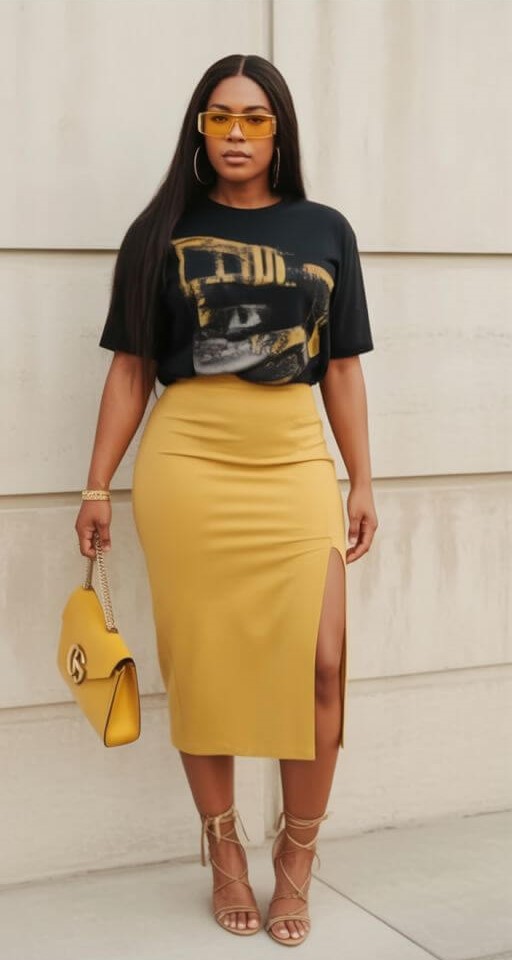
If both halves are voluminous, the silhouette goes boxy and you’ve lost your waist. If both halves are super fitted, the look can read as a costume. The sweet spot is one fitted, one with movement, with the waist clearly visible somewhere in the middle.
This is why tucking matters so much for an hourglass. Even a half-tuck (front-tuck only) is enough to redraw the waistline. If a top is too long to tuck and not fitted enough to define the waist on its own, that’s where a belt comes in.
The Bottom Line
The hourglass is the proportional reference everyone else is styling toward. That’s the whole reason these rules exist: not to create curves, but to keep them visible. Stop fighting your shape, define your waist, and the rest follows.
Once you’ve made these 8 rules automatic, getting dressed becomes the easiest job in fashion.
Complete your style transformation by exploring my comprehensive body type guides for apple, pear, inverted triangle, rectangle, and hourglass figures to discover the perfect styling tips for your unique shape.
Photo source: Pinterest